Artists
RICHARD GALPIN
Richard Galpin (b. Cambridgeshire, UK, 1975) graduated from Goldsmiths MA (2001). In 2010 he completed a public commission, Viewing Station, for the High Line, the elevated public park on a disused freight track in Chelsea, New York. Galpin lives and works in London.
Selected solo exhibitions include Franklin Art Works (Minneapolis), Brancolini Grimaldi Arte Contemporanea (Rome), Galeria Leme (Sao Paulo), Roebling Hall (New York), and Hales Gallery (London). Selected group exhibitions include shows at Temple Bar Gallery (Dublin), The Bolsky Gallery (Los Angeles), the British Museum (London), Von Lintel Gallery (New York), Marcel Sitcoske Gallery (San Francisco) and at Courtauld Institute of Art (London). Galpin's work can be found in numerous collections including the British Government Art Collection (UK), British Museum (UK), Victoria & Albert Museum (UK) and Deutsche Bank.
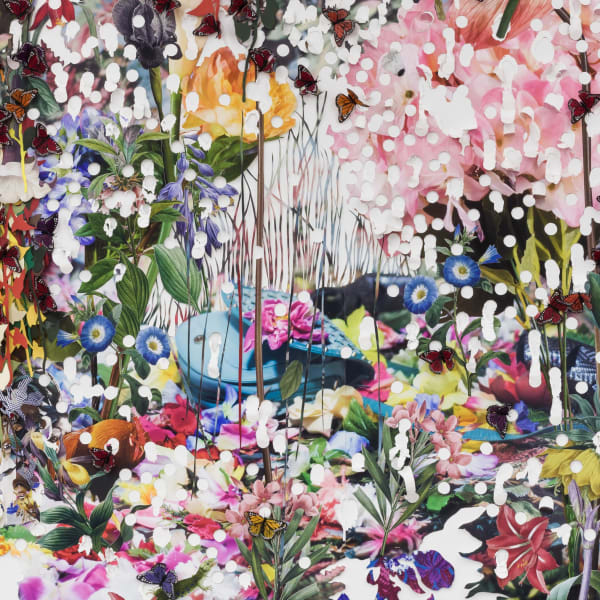
Galpin produces dynamic and fantastical works that are derived from the artist's own photographs of chaotic cityscapes. Using only a scalpel Galpin intricately scores and peels away the emulsion from the surface of the photograph to produce a radical revision of the urban form. The artist allows himself no collaging or additions of any kind - each delicate work is a unique piece made entirely by the erasure of photographic information. The works enact a reimagining of the city, but their futuristic vision is predicated on the city as it is now, with the intricate details bearing traces of contemporary urban experience. The overpowering city becomes almost and sometimes completely unrecognizable in the intricate web of cut-outs and transforms into a coded message created by the artist.
Playing between abstraction and representation, the works draw their visual language from early 20th Century movements such as Constructivism, Cubism, and Futurism. Galpin subjects his photographs of London and New York to a cubo-futurist vocabulary influenced by the early 20th century wartime studies of British artists Edward Wadsworth, C. R. W. Nevinson, and Graham Sutherland. Through combining this aesthetic with the reflective surfaces of contemporary cities, the works have manifested a shard-like angularity reminiscent of science-fiction illustration, the architectural drawings of Lebbus woods, or the sculptures of Lee Bondecou.